Senior Dog Walk Length for Labs and German Shepherds

For a senior Labrador or German Shepherd, the right walk is usually shorter, steadier, and more consistent than it was in adulthood. In most cases, aging large breed exercise should shift toward low-impact daily walks, adjusted to your dog’s comfort, mobility, and recovery rather than sticking to a fixed distance or step target.
When a Labrador or German Shepherd becomes a senior
Large breeds often reach their senior stage earlier than small dogs, so it makes sense to revisit your routine before your dog looks “very old.” AAHA defines a senior dog as one in the last 25% of its estimated lifespan, which is especially relevant for larger breeds such as Labradors and German Shepherds.
That matters because your dog’s exercise needs may start changing gradually, not all at once. A dog who still loves walks may still need a different pace, terrain, or total daily volume than they did a few years ago.
- Labrador Retrievers: Often stay enthusiastic about walks and retrieving games, but extra body weight and age-related stiffness can make long outings harder.
- German Shepherds: Often remain mentally driven and eager to work, but may show slowing, stiffness, or reduced tolerance for repeated impact as they age.
Instead of asking, “How far should a senior dog walk?” it helps to ask, “How much controlled activity can my dog do comfortably today, and how do they feel afterward?” That is the more useful way to set a senior dog walk length.
Why older large-breed dogs need a different walking plan
The key change is not that older dogs should stop moving. It is that regular movement still matters, but the dose and style need to fit the dog in front of you.
AKC notes that regular walking can help senior dogs maintain muscle tone and support aging joints, while also recognizing that very old dogs may need less walking volume than they did when younger. AKC also describes walking as an excellent low-impact exercise for senior dogs, with benefits for both body and mind.
AAHA’s senior-pet guidance makes the same point from a veterinary angle: low-impact exercise is preferred for many older pets, and activity should be adjusted to mobility and comfort. For many aging Labs and Shepherds, that makes walking a better default than high-impact play, repeated jumping, or long runs beside a bike.
Breed differences that affect daily walks
Both breeds are large, athletic dogs, but they do not always age in the same way.
- Aging Labrador activity: Labs are often highly food-motivated and can gain weight easily, so daily movement and body-condition management matter a lot. Merck Veterinary Manual emphasizes that weight optimization is crucial in canine osteoarthritis because excess weight can worsen mobility and pain.
- German Shepherd senior walks: German Shepherds are often more driven by patrol-style movement, scanning, and purposeful walking. Many do well with structured, moderate walks that include sniffing and mental engagement without lots of sharp turns, jumping, or sudden bursts.
- Large-breed wear and tear: Bigger bodies place more load through joints and soft tissues. That does not mean your dog should rest all day; it means controlled, repeatable movement usually works better than weekend overdoing.
If your dog has stiffness, limping, reluctance to rise, slowing on stairs, or trouble after activity, talk to your veterinarian. Those signs can change how you should handle aging large breed exercise.
How long should a senior dog walk each day?
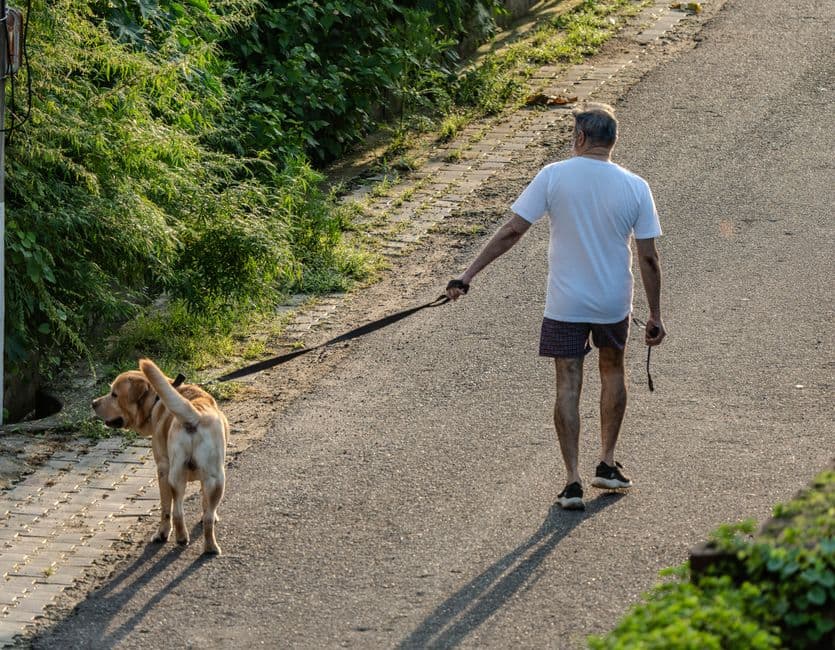
There is no one senior dog walk length that fits every older Labrador or German Shepherd. A better approach is to split daily activity into manageable sessions and increase only when your dog stays comfortable during the walk and afterward.
For older or arthritic dogs who are not already in a regular routine, VCA advises starting with short, frequent walks. A practical starting point can be 10 minutes three times daily, then increasing only if stiffness does not worsen.
| Dog stage | Useful starting point | What to watch |
|---|---|---|
| Newly slowing senior, still comfortable | 2 to 3 steady walks per day, often around 10 to 20 minutes each | Next-day stiffness, lagging, panting, slowing late in walk |
| Older dog returning to routine after inactivity | About 10 minutes, 3 times daily | Worsening stiffness after rest, reluctance to go out again |
| Dog with known arthritis or mobility limits | Short, controlled walks on forgiving surfaces | Limping, shortened stride, stopping, soreness later |
These are starting points, not rules. Some older Labs can still comfortably handle longer daily totals if the pace is easy and recovery is good. Some senior German Shepherds do better with several brief outings rather than one longer walk.
A simple way to adjust walk length
- Start with a comfortable duration your dog can finish without dragging or stiffening up later.
- Keep that same amount for several days.
- If your dog stays loose and willing, add a small amount of time to one walk.
- If your dog seems more stiff afterward or the next morning, scale back.
This is where tracking total daily activity can help. A breed-tuned approach like Pawmi’s focuses on the whole day, not just a single outing, so you can spot when several small walks are a better fit than one big push.
Best walking style for older Labs and Shepherds
For most senior large breeds, how you walk matters as much as how long you walk. Controlled, low-impact movement is often the safest and most sustainable option.
VCA states that controlled, regular exercise is a core part of care for dogs with osteoarthritis, along with weight control, rehabilitation, and pain management. Merck also advises that regular, controlled exercise is beneficial, and its dog-owner guidance suggests soft surfaces may be easier for arthritic dogs than long stretches on hard pavement.
What usually works better
- Steady leash walks: A moderate, even pace is often easier than stop-start chaos.
- Soft terrain: Grass, packed dirt, or other forgiving surfaces may be more comfortable than long pavement routes.
- Shorter, more frequent outings: This often helps dogs who get stiff after one long effort.
- Warm-up time: Let your dog ease into the walk rather than heading straight into a brisk pace.
- Sniff breaks: Mental enrichment can make a shorter walk feel more satisfying without adding impact.
What often needs reducing
- Repeated ball chasing with hard stops and twists
- Jumping in and out of vehicles without help
- Long walks on hot pavement or very uneven ground
- Trying to “make up for” missed days with one extra-long outing
Labs may still beg for another throw long after their joints have had enough. German Shepherds may keep working because they are driven and responsive. In both breeds, willingness is not always the same as comfort, so watch movement quality, not just enthusiasm.
Signs you should shorten, split, or rethink the walk
Your dog’s body will usually tell you when the current plan is too much. The most helpful clues often show up after the walk, not during the first few minutes.
- Stiffness after lying down
- Slower rising from bed
- Limping or favoring a leg
- Falling behind on the return leg of the walk
- Reluctance to use stairs or jump into the car
- Heavy panting out of proportion to the effort or weather
- Less interest in going out again later the same day
If you notice these patterns, shorten the walk, switch to softer ground, or split one longer outing into several shorter ones. If the signs continue, consult your vet. Health issues such as osteoarthritis are common in older large breeds, and your veterinarian can help you decide whether the problem is exercise load, pain, body weight, or something else.
Weather matters more with age
Older dogs often cope less well with heat, humidity, and slippery winter footing. On hot days, go earlier or later, keep sessions shorter, and favor shaded routes. On cold or wet days, many dogs do better with brief outdoor walks plus indoor enrichment.
A practical daily plan for an aging Labrador or German Shepherd
The best routine is one your dog can recover from well day after day. Consistency usually beats occasional long efforts.
Example framework
- Morning: Easy walk to loosen up, often the slowest start of the day.
- Midday: Short comfort walk or sniff-focused outing.
- Evening: Main steady walk, kept controlled and adjusted to how your dog moved earlier.
If your dog is just starting to slow down, the evening walk may still be the longest. If your dog has diagnosed arthritis or obvious stiffness, three shorter walks may work better than one long one. VCA’s 10-minutes-three-times-daily starting point is especially useful when rebuilding activity gradually.
Support the walk outside the walk
- Keep body weight in a healthy range; Merck emphasizes this as a major part of osteoarthritis management.
- Use rugs or runners indoors if floors are slippery.
- Help with car entry if jumping looks hard.
- Log daily activity and recovery so you can see patterns over time.
That last point matters because senior needs can change month to month. A personalized, breed-tuned daily goal based on breed, age, weight, and health can be more realistic than a generic step number, especially for older large breeds whose good days and slower days may look different.
The takeaway: for older labrador activity and german shepherd senior walks, aim for controlled, low-impact, regular movement that your dog handles comfortably. If you are seeing stiffness, limping, or a sudden drop in tolerance, talk to your veterinarian before increasing exercise.
Sources
- AAHA: Senior care and defining the senior life stage
- AAHA: Aging With Grace — how to support your senior pet
- AKC: Senior Dogs
- AKC: How to Provide Senior Dog Proper Exercise
- VCA Animal Hospitals: Exercising Dogs With Osteoarthritis
- Merck Veterinary Manual: Osteoarthritis in Dogs and Cats
- Merck Veterinary Manual: Osteoarthritis (Degenerative Joint Disease) in Dogs